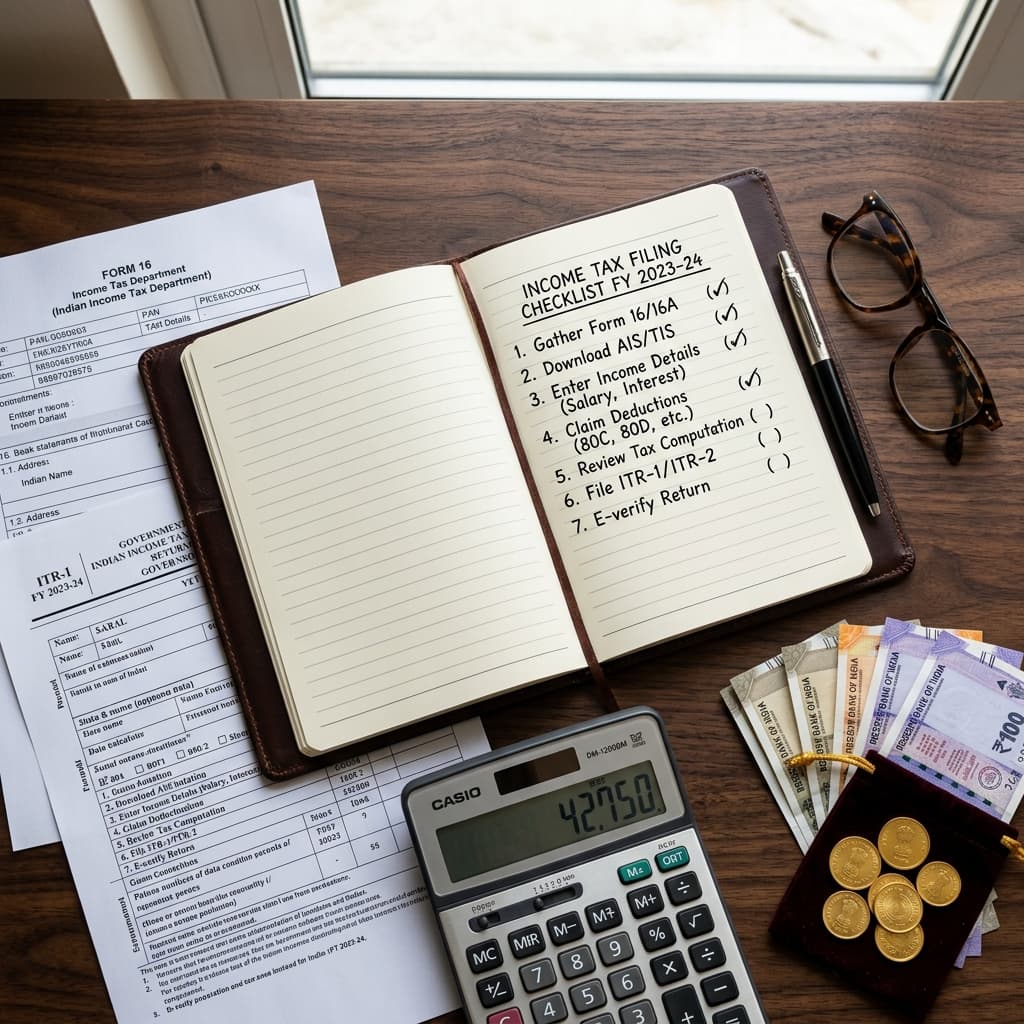
Documents, deductions, and deadlines — a clear checklist to make this year's filing accurate and stress-free.
Filing your income tax return accurately depends almost entirely on gathering the right documents before you start, not after. Most errors — and most notices — trace back to missing information that causes the return to be filed in a rush with wrong figures.
Documents to collect
- Form 16 (if salaried) or Form 16A from all TDS deductors
- Bank statements for all accounts — savings, current, and NRE/NRO if applicable
- Capital gains statements from your broker (consolidated account statement from CAMS/KFintech for mutual funds)
- Home loan interest certificate and principal repayment certificate from your lender
- Rent receipts if claiming HRA, or rental income details if you are a landlord
- Investment proofs for 80C, 80D, 80G deductions
- Form 26AS and Annual Information Statement (AIS) downloaded from the Income Tax portal
Reconcile AIS before filing
The Annual Information Statement now aggregates data from banks, registrars, brokers, and GST returns. The department cross-checks your ITR against this data automatically. If the two diverge — even because of a data error in AIS — expect a notice. Review every line item in AIS before filing and raise a feedback objection for anything that is incorrectly attributed to you.
"Filing a correct return is straightforward. Filing it without first reading your AIS is where most problems begin."
Key deadlines for FY 2025-26
- 31 July 2026 — ITR for individuals and HUFs not requiring audit
- 31 October 2026 — ITR for businesses subject to tax audit
- 30 November 2026 — ITR for businesses with transfer pricing requirements
- 31 December 2026 — Belated or revised return deadline
A belated return filed after 31 July attracts a fee of ₹5,000 (₹1,000 if total income is below ₹5 lakh). More importantly, it forfeits your ability to carry forward certain losses — a cost that is rarely visible until the following year.